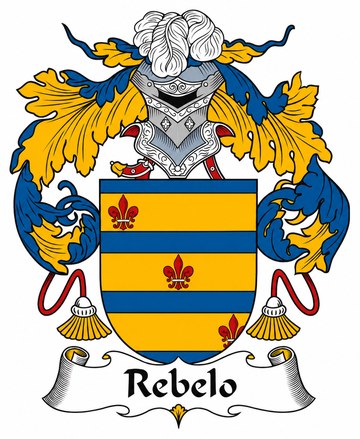
What does Rebelo mean?
Rebelo is a Portuguese surname of local (habitational) origin. In classical onomastics, that means the first bearers were identified with a place or estate, “the people of Rebelo,” or “from the house of Rebelo.” The ancestral seat of one early line is often placed at Santa Justa in Lisbon; other traditions also connect the name with lands near Guarda and with a protected estate known as the Couto de Rebelo (or Rabello).
Historical spellings include Rebelo, Rebello, Rabelo, and Rabello. Scribes, regional speech, and colonial registries all shifted letters. The form Rebello is especially common in Goa and other former Portuguese India, where Portuguese surnames arrived with settlers, soldiers, and clergy from the 16th century.
Folk etymology sometimes hears “rebel” in the name (defiance, independence, a restless spirit). That reading is popular and poetic, but the scholarly default is geographic: the name points to land and lordship, not necessarily a temperament. Many Portuguese surnames work the same way (a village, a river, a manor becomes a family label).
A short timeline
-
c. 1139-1147
Paio Delgado fights with Afonso Henriques at Ourique and in the conquest of Lisbon. Genealogical tradition’s progenitor of the house.
-
Medieval
Rui Vasques Rebelo takes the estate name; lords of Lobão and Rebelo appear in later centuries.
-
1500s-1600s
Age of Discovery spreads Portuguese surnames; Rebello appears in Asia; court culture elevates composers and painters named Rebelo.
-
1610-1661
João Lourenço Rebelo writes polychoral sacred music for the Braganza court.
-
c. 1600-1657
José de Avelar Rebelo serves as royal painter under João IV, including themes of Lisbon’s Christian conquest.
-
1921-2002
Baltazar Rebelo de Sousa, physician and high political office under the Estado Novo.
-
2016-2026
Marcelo Rebelo de Sousa serves two terms as President of Portugal, the name’s most global modern stage.
Paio Delgado, companion of Afonso Henriques
If one figure stands at the mythic doorway of Rebelo history, it is Paio Delgado (also rendered Payo Delgado in older spelling). Portuguese genealogical and heraldic tradition names him a fidalgo of the time of King Afonso Henriques (Afonso I), the first king of Portugal.
He is remembered as a companion-in-arms in the wars that forged the kingdom: the legendary Battle of Ourique (25 July 1139) and, most crucially for the family’s Lisbon story, the conquest of Lisbon from the Moors in 1147. That siege, a joint effort of Portuguese forces and northern crusaders on their way to the Holy Land, remade the Tagus capital as a Christian city and a royal prize.
Tradition also credits Paio Delgado with founding a hospice or hostel (albergaria) associated with his name, charity and pilgrimage infrastructure typical of medieval Christian elites. From this knightly household, later generations are said to have held land that became known as Rebelo; descendants then used that place as a surname.
How to read this carefully: Paio Delgado appears in Portuguese historical memory as a real type of figure, a noble warrior of the first Portuguese king. The direct line from him to every modern Rebelo is a claim of family tradition and older genealogies, not a single DNA chart or uncontested modern monograph. Different Rebelo branches (mainland, Madeira, Brazil, Goa) may share a name without sharing one medieval grandfather. Still, as a foundation story, the knight of Lisbon 1147 is the most prominent medieval figure attached to the house.
Rui Vasques Rebelo, lord of the Couto
Rui Vasques Rebelo (Rui Vasques “de Rebelo,” sometimes Rui Rebelo Vasques) is the figure most often named as the first to bear Rebelo as a hereditary surname. Genealogies style him a principal fidalgo and senhor do Couto e Solar de Rebelo, lord of the protected estate and manor house of Rebelo.
In medieval Portugal a couto was a privileged, often immunised territory; a solar was the ancestral house. Taking the name of that estate was how many Portuguese lineages “froze” a place into a last name. Rui Vasques thus sits at the hinge: after the knightly founder comes the landholder who makes Rebelo a word you inherit.
He is typically presented as a descendant in the line associated with Paio Delgado, the bridge from sword and siege to surname and solar.
Lords, seats, and the growing house
Early notabilities include Afonso Martin, recalled as lord of Lobão and Rebelo in the 13th century, evidence that the place-name and the seigneurial title remained linked long after the first surname-bearers. The house’s Lisbon connections (Santa Justa and the post-conquest city) sit alongside northern and interior estates in the documentary imagination of genealogists.
Across the later Middle Ages and early modern period, people called Rebelo appear as landowners, clergy, royal servants, and municipal figures. Not every mention is the same lineage; surname identity in Iberia is often a cloud of related and unrelated houses sharing a toponym. What unites them culturally is the Portuguese world they inhabited: Reconquista memory, Atlantic expansion, and Catholic institutional life.
João Lourenço Rebelo, court composer
João Lourenço Rebelo (also João Soares Rebelo; c. 1610 to 16 November 1661) is among the most artistically important people ever to carry the name. Born in Caminha, he entered the musical household of the Dukes of Braganza as a youth and became the outstanding Portuguese exponent of the Venetian polychoral style: massive, multi-choir sacred music associated with St Mark’s in Venice.
He was close to the future King John IV (João IV), a music-loving monarch who valued Rebelo highly. His surviving reputation rests on psalms, Magnificats, Lamentations, and other liturgical works that place Portuguese court music on a European map. If Paio Delgado is the sword of the origin story, João Lourenço is its polyphony, culture at the height of the Braganza restoration era.
José de Avelar Rebelo, royal painter
José de Avelar Rebelo (c. 1600-1657) was a Portuguese painter of the mid-17th century, appointed royal painter to King João IV. His work sits in the same Braganza cultural flowering as João Lourenço’s music. Among themes associated with his output is the Christian conquest of Lisbon, a subject that, for a family named after a house born in that city’s medieval drama, feels almost circular: a Rebelo brush returning to the siege a Rebelo knight is said to have fought.
Empire, Goa, Brazil, and the Atlantic
As Portugal built an oceanic empire, surnames travelled with soldiers, merchants, missionaries, and administrators. Rebelo / Rebello appears in Brazil, in African posts of the Portuguese crown, and prominently in Goa and other enclaves of Portuguese India. There the spelling Rebello often stabilised and entered local Catholic communities for centuries.
Figures such as military captains and colonial officials named Rebelo show up in chronicles of the Estado da Índia and Atlantic service. They are not always genealogically tied to the medieval solar (empire recycled Portuguese names at scale), but they expanded what “a Rebelo” could mean on the map: not only a Lisbon or Guarda house, but a global Lusophone surname.
Baltazar Rebelo de Sousa, doctor and minister
Baltazar Leite Rebelo de Sousa (16 April 1921 to 1 December 2002) was a Portuguese physician and politician of the late Estado Novo. He held major offices including Governor-General of Mozambique (1968-1970) and portfolios connected with corporations, health, and overseas affairs, ending as Minister for the Overseas on the eve of the Carnation Revolution of 25 April 1974.
His career is inseparable from a contested period of Portuguese history: colonial administration and authoritarian rule. After the revolution he lived in exile for a time in Brazil. Historically he matters both as a high official of his era and as the father of Marcelo Rebelo de Sousa, who would later lead the democratic republic as president.
Marcelo Rebelo de Sousa, President of Portugal
Marcelo Nuno Duarte Rebelo de Sousa (born 12 December 1948 in Lisbon) is the most internationally famous living bearer of the name. A professor of law, journalist, and co-founder of the influential weekly Expresso, he spent decades as a political analyst before winning the presidency in 2016 and a second term in 2021, serving until 2026.
He helped draft democratic Portugal’s constitutional culture as a young parliamentarian after 1974, served as a minister, and led the Social Democratic Party in the 1990s. As president he became known for an informal, highly public style (hospital visits, disaster sites, a constant presence in national life) that made “Marcelo” and “Rebelo” household words far beyond specialist history.
For surname history, his importance is simple: no earlier Rebelo occupied so visible a constitutional role for so long. The medieval knight and the modern president bookend a nearly nine-century story of the name in Portuguese public life.
Rebelo and Madeira
The family behind therebelo.com belongs to the island of Madeira, the Atlantic archipelago settled by the Portuguese in the 15th century, famous for wine, levadas, Laurissilva forest, and a mild climate. Madeiran Rebelos are one chapter of the wider surname: island life, emigration waves, and a fierce attachment to place.
Whether a given Madeiran line descends from the Lisbon solar of tradition, from later mainland migrants, or from parallel adoptions of the same place-name is a question for parish registers and careful genealogy. What is certain is cultural: on Madeira the name has meant neighbours, godparents, harvests, and tables set with espetada and bolo do caco, living heritage, not only parchment.
Explore more of that bond on the home page and in the photo gallery.
How we know (and what remains open)
This page draws on Portuguese historical consensus for well-documented public figures (presidents, ministers, composers, painters) and on genealogical and heraldic tradition for the medieval origin of the house (Paio Delgado, Rui Vasques Rebelo, the Couto and Solar). Onomastic descriptions of Rebelo as a habitational surname are standard in surname references.
We do not claim that every person named Rebelo shares one bloodline, or that every detail of 12th-century genealogy is proven in modern archival monographs. Medieval Portuguese family trees are often reconstructions. Where tradition is the source, we say so.
If you have parish records, a Madeira line, or a documented branch you want reflected here, that is the kind of detail that makes a family site truer over time.
Continue exploring
Return to the Madeira story, or see the island in photographs.